
Managing a project with several different vendors can be a hassle. A full-service fabrication shop makes things easier by offering everything in one place. At TAB, we take care of the entire process, from design to logistics, so you can focus on what matters most. Here's what that means If you manage a warehouse, manufacturing plant, distribution center, or any large commercial facility, you already know that air quality and temperature control aren't just a comfort issue. They are also productivity and safety issues. Industrial fans are one of the most effective tools for tackling both, but with so many types on the market, it can be hard to know where to start.
This guide breaks down what industrial fans are, the main types available, where they get used, and what to actually look for when choosing one for your space.
What Is an Industrial Fan?
An industrial fan is a mechanical device designed to move large volumes of air through a space. Unlike residential or commercial fans, industrial fans are built for continuous, heavy-duty operation in demanding environments. They are engineered to handle high temperatures, dust, humidity, and the sheer scale of large open floor plans.
Industrial fans serve a few core purposes. They improve ventilation, help regulate temperature, reduce humidity, remove airborne contaminants, and take pressure off HVAC systems that struggle to maintain consistent conditions across a big facility.
Types of Industrial Fans
Industrial fans fall into a few broad categories, each suited to different airflow needs and environments. The Air Movement and Control Association (AMCA) is the industry standards body that sets testing and performance benchmarks across all fan types, and its classifications are widely used across the industry.
Axial Fans
Axial fans move air parallel to the fan's axis of rotation. They're high-volume movers and are commonly used for general ventilation and cooling. Ceiling-mounted axial fans, particularly high-volume low-speed (HVLS) fans, are among the most popular choices for large open facilities because they can circulate air across enormous square footage without burning through a lot of energy.
Centrifugal Fans
Also called blowers, centrifugal fans use a rotating impeller to push air outward from the center. They're well-suited for applications that require moving air against higher resistance, like through ductwork, filtration systems, or exhaust setups. You'll find them in manufacturing processes, pollution control systems, and HVAC ducting.
High-Volume, Low-Speed (HVLS) Ceiling Fans
HVLS fans deserve their own spotlight because of how widely adopted they have been through industrial warehouses. These large-diameter ceiling fans, typically ranging from 8 to 24 feet across, rotate slowly but move enormous columns of air downward. The result is a floor-level breeze that can be felt across thousands of square feet.
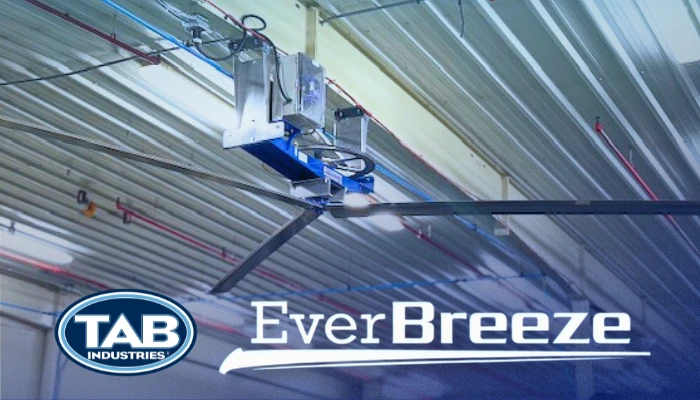
They're especially useful in facilities where adding more HVAC infrastructure isn't practical or cost-effective. This is exactly the technology behind the TAB EverBreeze fans, which are available in 16-foot and 21-foot diameters to fit a range of facility sizes.
Common Use Cases for Industrial Fans
Industrial fans show up in virtually every sector that involves large spaces and physical work. Here's where they tend to make the biggest difference.
Warehouses and Distribution Centers
Temperature is a persistent problem in tall warehouse spaces. Hot air collects near the ceiling while cooler air settles near the floor. Industrial ceiling fans fix this by pushing warm air down in winter and creating a cooling effect in summer. This reduces the load on HVAC systems and can noticeably lower energy bills.
Manufacturing and Production Facilities
Workers on production floors need consistent, comfortable conditions to stay focused and avoid heat-related safety issues. Industrial fans provide steady airflow without creating turbulence that might disrupt lightweight materials or sensitive processes. They also help manage fumes and airborne particulates when used as part of a broader ventilation setup.
Agricultural Buildings
Barns, poultry houses, and livestock facilities rely on industrial fans to regulate temperature, control moisture, and prevent the buildup of harmful gases like ammonia. Good ventilation in agricultural settings directly affects animal health as well.
Gymnasiums, Arenas, and Large Public Spaces
Large gathering spaces with high ceilings and unpredictable occupancy levels benefit a lot from HVLS fans. They move air effectively without the noise or energy draw of running multiple smaller fans at once.
Cold Storage and Food Processing
In refrigerated environments, industrial fans help maintain temperature uniformity and prevent frost buildup. In food processing plants, they support air quality and temperature control while meeting health and safety requirements.
How to Choose the Right Industrial Fan
Picking the right industrial fan comes down to understanding your space, your goals, and the conditions the equipment will need to withstand. Here are the main things to think through.
Ceiling Height and Floor Area
HVLS ceiling fans work best in spaces with high ceilings and large open floor plans. The bigger the fan diameter, the more floor area it can effectively cover. For spaces with lower ceilings or more segmented layouts, axial or centrifugal fans in a distributed setup might better suit your needs.
Energy Efficiency
Operating costs matter a lot over the life of the equipment. HVLS fans are notably energy-efficient. A single large fan running at low speed often uses less power than several smaller high-speed fans trying to cover the same space. Variable-speed controls and energy-efficient motors are worth considering.
Controls and Automation
Modern industrial fans increasingly come with digital controls, thermostatic automation, and integration with building management systems. Being able to tie airflow to temperature thresholds rather than running fans at full speed all day is a meaningful efficiency gain.
Installation
Large ceiling fans need proper structural support and electrical wiring. Pre-wired electrical panels and support for multiple voltage configurations can simplify installation quite a bit. It's also worth thinking about long-term maintenance access before you commit to a mounting location.
Looking for a Fan That's Actually Built for the Job?
If you're evaluating HVLS ceiling fans for a warehouse, production facility, or large commercial space, the TAB EverBreeze line is worth a look. Available in 16-foot and 21-foot diameter options, they're built with heavy-duty motors, reinforced mounting systems, and precision-engineered blades that move serious air without running up your energy bill. Digital and thermostatic control options let you manage your facility's climate the way you want to.
Reach out to TAB Industries for a quote and find the right setup for your space.