
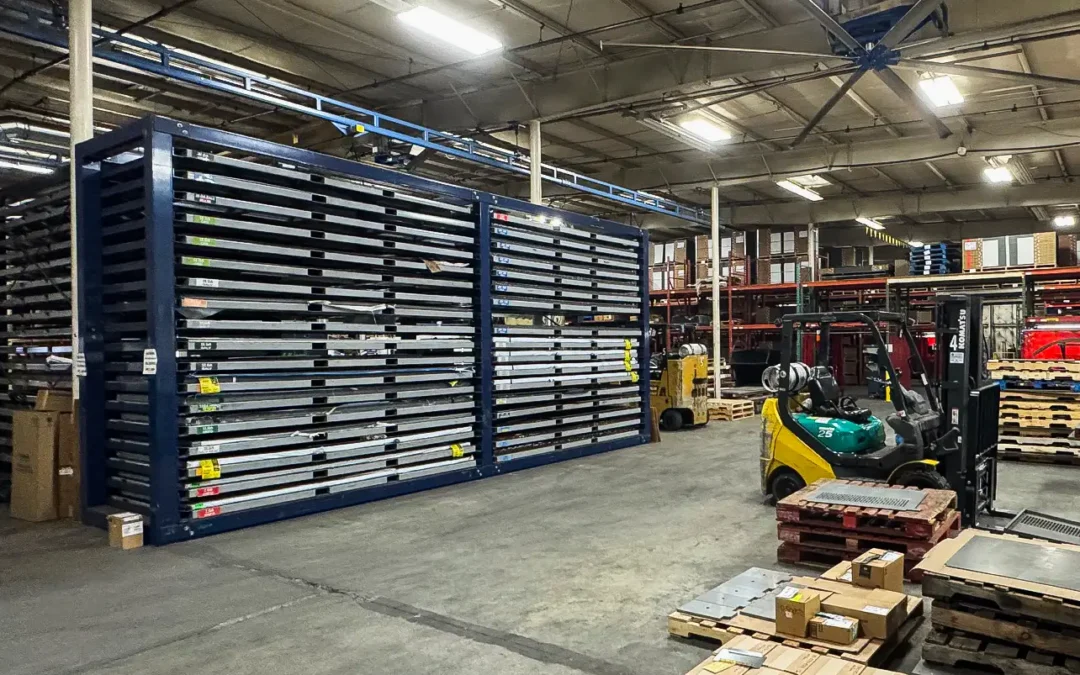
Walk any metal fabrication shop, and you'll see it. A corner, or worse, a whole bay, stacked flat with sheet metal. Nobody planned for that space to become storage. It just happened, sheet by sheet, until it was.
It's the forklift that has to take the long way around. The staging area that keeps shrinking. The production line that could run faster if there were just room to stage the next job. Floor space is one of the few assets a shop can't manufacture more of, and right now, a good chunk of it is being spent on something that isn't making money.
That's the exact problem the TAB Stacker was built to solve: turning that wasted footprint into organized, high-density vertical storage.
Why Flat-Stacked Storage Costs More Than It Looks Like
Horizontal sheet storage feels free because there's no line item for it. But it's quietly expensive in ways that show up everywhere except the P&L.
- It eats aisle space. Flat stacks spread out, which means less room for forklifts to maneuver and more three-point turns eating into cycle time.
- It damages material. Sheets stacked directly on the floor, or on pallets never designed to carry them, scratch, warp, and dent. That's scrap cost and rework hiding in plain sight.
- It buries inventory. The sheet you need is always the one on the bottom. Finding it means unstacking everything on top of it first, which turns a two-minute pull into a fifteen-minute one.
- It's a safety liability. Manual handling of heavy, awkward sheet stock, especially when it's stacked flat and has to be shifted by hand or pried apart, is exactly the kind of task that leads to strains, pinches, and worse.
None of this shows up as a single dramatic event. It shows up as friction, a little slower, a little riskier, a little more cluttered, every day.
The Shift: Thinking Vertically
The fix isn't finding more floor space. It's using your floor space differently.
Sheet metal doesn't have to sprawl throughout your shop floor. When it is stored vertically, on the right equipment, the same footprint that used to hold a few flat stacks can hold dramatically more material that’s organized, separated, and accessible sheet by sheet instead of buried under a pile. It's less a product upgrade than a rethink of what storage is supposed to do, which is keep material safe and ready, not just out of the way.
How the TAB Stacker Gets It Done
This is exactly the problem the TAB Stacker was built to solve, with hardware, not hype.
- Capacity: Holds up to 90,000 lbs of sheet metal across 18 pallets, at 5,000 lbs per pallet.
- Sheet size: Built for standard 60" x 120" (5' x 10') sheet stock.
- Construction: Heavy-duty steel with a powder-coated finish for durability in a working shop environment.
- Forklift access: Oversized fork-tubes for easy, secure entry, no fighting to get a pallet in or out.
- Organization: Each pallet stays separate and accessible, so material is never buried under the next sheet down.
It's straightforward equipment doing a straightforward job, turning wasted floor space into organized, high-density storage that doesn't get in anyone's way.
Who This Is Perfect For
This may not be a fit for every business, but for certain operations, it solves a problem that's been sitting there for years.
Metal fabrication shops running multiple jobs at once, where different gauges, finishes, and sheet sizes all need to stay sorted and within reach. When sheets are flat-stacked, that sorting either doesn't happen or eats up labor hours every time a new job comes in. Vertical storage keeps each sheet type separated and ready to pull.
Job shops that live and die by turnaround time. If a shop is quoting fast jobs and just-in-time material pulls, the difference between grabbing a sheet in thirty seconds versus digging for five minutes adds up fast across a week of orders. This is the audience that feels buried inventory the most acutely, because their whole business model depends on speed.
Manufacturing plants where sheet metal is a feeder material into a larger production line. Here, the bottleneck isn't the fabrication step itself; it's getting the right material to the line without a forklift detour through a cluttered staging area. Freeing up that space can mean a shorter, safer path from stock to press.
Shops that have outgrown their building but can't move. Not every operation can expand its footprint when volume grows. For shops boxed in by their existing four walls, vertical storage is often the only real lever left to pull for more capacity without a construction project.
Any shop with a near-miss report tied to material handling. If there's already been an incident, or a close call, involving someone shifting or prying apart flat-stacked sheet stock, that's a strong signal the current storage setup has become a liability rather than just an inconvenience.
The common thread across all of these is a shop where floor space, safety, or speed of access is actively limiting how much work can get done, not just a mild annoyance in the back corner.
The Payoff of Vertical Storage
Done right, vertical storage isn't just tidier; it changes the math on the floor.
- More usable floor space for production, staging, or throughput
- Safer material handling, with less manual repositioning of heavy stock
- Faster access to inventory, grab the right sheet without unstacking the rest
- Less time lost to searching, shuffling, and rework from damaged material
See If the TAB Stacker Fits Your Shop
No hard sell here, just worth a look if floor space or sheet handling has been on your mind. See if vertical storage makes sense for your shop or request a quote to talk through your specific layout.